


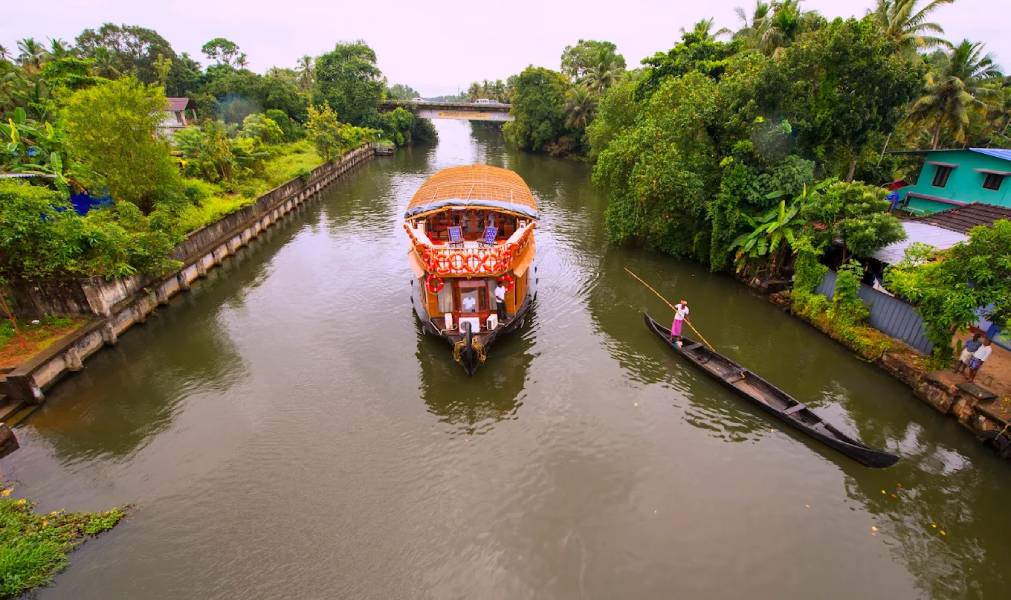
kaziranga national park by river - the wildlife experience no road safari provides
- Hotel
Kaziranga National Park by River - The Wildlife Experience No Road Safari Provides
Most visitors to Kaziranga National Park arrive by road from Guwahati — a four-hour drive through the flatlands of Assam, boarding a jeep or elephant and hoping for rhinoceros. It is a fine way to see the park. But it is not the only way — and it is not the best way.
The Brahmaputra River forms the entire northern boundary of Kaziranga. The park's famous central and eastern zones run down to within metres of the river's edge. The animals that live in those zones — the rhinoceros, the wild elephant, the swamp deer, the fishing eagle — drink from the same water the M.V. Mahabaahu glides across at dawn. Seeing Kaziranga from the river is a perspective that changes how you understand it.
Kaziranga — Why It Matters
Kaziranga National Park is a UNESCO World Heritage Site and one of the most remarkable conservation success stories of the 20th century. In 1905, when it was first protected by the British Raj following lobbying by the Viceroy's wife, the one-horned rhinoceros population had been hunted to fewer than 20 individuals.
Today Kaziranga protects approximately 2,613 rhinoceroses — more than 70 percent of the world's total population of this species. The park also supports over 1,000 wild elephants, 120 tigers, significant populations of wild buffalo, swamp deer and hog deer, and over 480 bird species. Per square kilometre, Kaziranga has the densest population of wildlife of any national park in Asia.
For international travellers arriving from European or North American wildlife traditions, Kaziranga is a revelation. The density of large mammals in an accessible area makes it one of the most reliably spectacular wildlife destinations on earth.
What the River Shows You That the Road Cannot
The Brahmaputra riverbank at the edge of Kaziranga is ecologically different from the park's interior. It is the edge habitat — the transitional zone between the river's open water and the tall elephant grass of the floodplain. Edge habitats support disproportionate biodiversity because they combine the resources of two different ecosystems simultaneously.
From the deck of the M.V. Mahabaahu, moving slowly at 5–6 knots along the park boundary at dawn, you are scanning this edge from a platform that the animals do not register as a threat. The rhinoceros on the riverbank — drinking, grazing in the shallows, occasionally swimming between sand islands — is behaving as it would with no human presence at all. This is fundamentally different from the approach of a jeep on a park road.
The fishing eagles hunt this water corridor relentlessly: Pallas's fish eagle, grey-headed fish eagle, lesser fish eagle. The river also offers the best chance of seeing the Gangetic river dolphin in this stretch — the dolphins follow the same fish concentrations the eagles hunt.
The Jeep Safari — What to Expect
Kaziranga is divided into multiple zones — the Western Range (Bagori), Central Range (Kohora), Eastern Range (Agoratoli), and Burhapahar Range. The Central and Eastern Ranges offer the highest density of rhinoceros sightings.
Adventure River Cruises arranges private jeep safaris into the park for all Brahmaputra cruise guests — these are not shared public-access vehicles. The vehicles leave before dawn during the hour when wildlife is most active. The naturalist who has been aboard the vessel throughout the cruise accompanies guests into the park, providing continuity of expert interpretation that a local vehicle driver alone cannot offer.
|
|
Elephant Safaris
Kaziranga offers limited elephant-back safaris at dawn in the Central and Western zones, operated by the park authority. These must be pre-booked and are subject to availability. Adventure River Cruises can arrange this for guests who wish to experience the park from elephant-back — a traditional method of wildlife viewing that predates the jeep and offers a unique height advantage over the tall grass.
The Greater Adjutant Stork — Kaziranga's Most Striking Bird
For international birdwatchers, Kaziranga's avifauna is extraordinary. But one species stands apart: the greater adjutant stork (Leptoptilos dubius) — a bird so large, so prehistoric-looking, and so rare globally that dedicated ornithologists travel specifically to Assam to see it.
Standing up to 145 cm tall with a wingspan of over 250 cm, the greater adjutant is one of the largest storks in the world. Its global population is estimated at fewer than 1,200 individuals, concentrated almost entirely in Assam and Cambodia. From the deck of the M.V. Mahabaahu, the greater adjutant is a regular sight along the river shallows — a sighting that stays with travellers for years.
Conservation and Community
Adventure River Cruises maintains direct relationships with park authorities and local communities. A portion of every cruise fare contributes to anti-poaching conservation efforts alongside Assam's Forest Department. The vessel's naturalists include former park rangers who maintain active knowledge of what is happening on the ground, bringing a depth of current insight that no external guide can provide.
The Mising community — whose villages cluster along the Brahmaputra bank adjacent to the park — are among the closest observers of Kaziranga's wildlife. Adventure River Cruises' community visits are designed to create direct economic benefit for riverside villages, providing an alternative income stream that reinforces the conservation value of keeping the park intact.
Planning Your Kaziranga Cruise
The Kaziranga corridor is covered on all Brahmaputra cruise itineraries — the 7-night, 10-night and 11-night departures all include Kaziranga jeep safari days.
|
|
|
|
|
|
|
|
|
|
|
|
|
|
|
|
|
|
|
|
|
|
|
|
|
|
|
|
|
|
Photography
The combination of low golden light on the water at dawn, large mammals at close range from a stable platform, and the extraordinary birdlife of the Kaziranga corridor makes this one of the finest wildlife photography locations in Asia. A 300–500mm telephoto lens is recommended. The M.V. Mahabaahu's bow deck provides a stable, unobstructed shooting platform with no vibration from road vehicles.
To check cruise availability and departure dates including Kaziranga safari days, visit adventurerivercruises.com